
You’ve heard the rumors: Dubai is expensive. Luxury cars, five-star hotels, designer malls - sure, all of that’s true. But here’s the twist: a lot of everyday stuff is shockingly cheap here. If you live in Dubai or are planning to visit, you’re sitting on a hidden treasure trove of savings. I’m not talking about tax-free shopping at the mall. I’m talking about groceries, fuel, phone plans, and even gym memberships that cost less than half what you’d pay back home. Let’s cut through the noise and show you exactly what’s cheaper - and why.
Gas Is Dirt Cheap - Like, Seriously
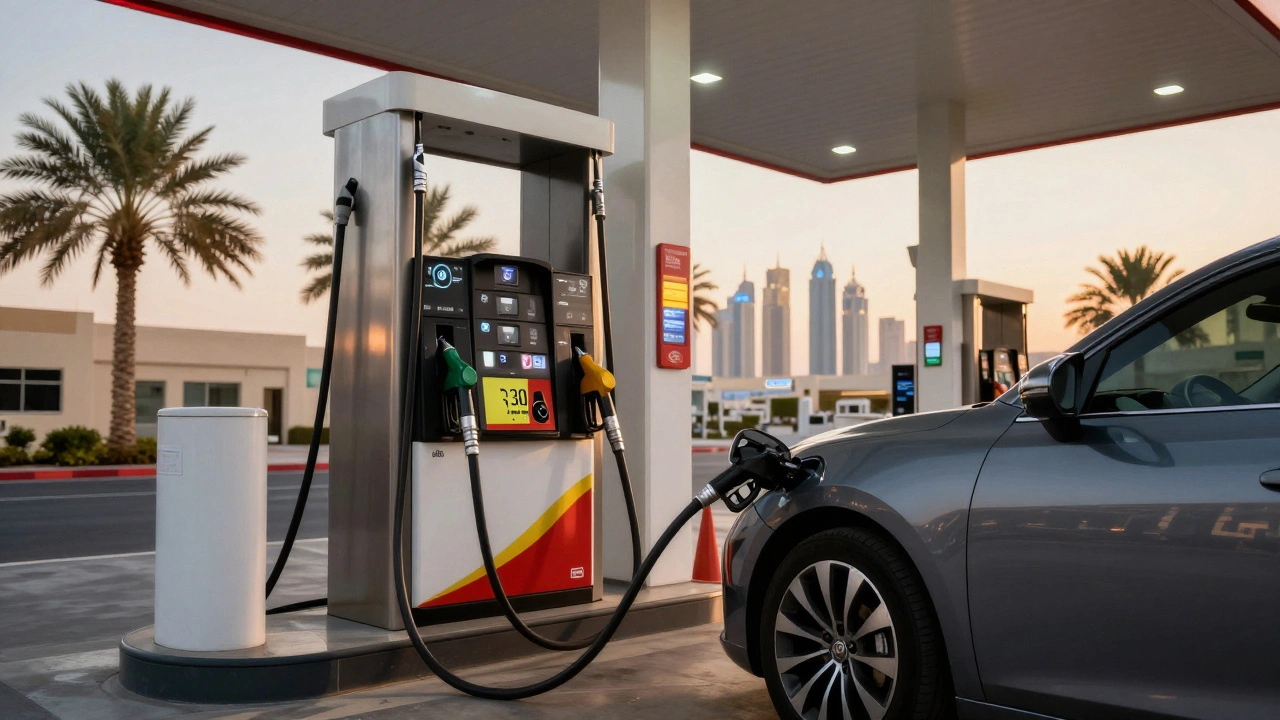
Fill up your car here, and you’ll probably stare at the receipt like it’s a mistake. A liter of 95-octane gasoline costs around AED 3.30 (roughly $0.90). Compare that to $4.50+ in the U.S. or £1.50 per liter in the UK. Why? Because Dubai produces its own oil. There’s no import tax, no refining markup, no political pressure to hike prices. You can drive a full tank for under AED 100 ($27) - and that’s enough to get you from Dubai to Abu Dhabi and back with room to spare. If you’re renting a car, this alone saves you hundreds a month.
Your Phone Bill? Half of What You Pay Elsewhere
Mobile plans in Dubai are a game-changer. Etisalat and du offer unlimited data, calls, and texts for as low as AED 99/month (about $27). That’s not a promo - it’s standard. In the U.S., you’d pay that much just for 10GB of data. Even premium plans with 100GB+ and 5G are under AED 199. No contracts. No hidden fees. You can walk into any Virgin Megastore or Carrefour and walk out with a SIM card in 10 minutes. If you’re on a work visa, your employer might even give you a free SIM. Don’t overpay for roaming - get local.
Groceries? Fresh, Fast, and Affordable
Think fresh produce in Dubai is pricey? Think again. Walk into any Lulu Hypermarket, Carrefour, or DMart, and you’ll find:
- 1kg of tomatoes - AED 4 (less than $1)
- 12 eggs - AED 8
- 1kg of chicken breast - AED 15
- 1L of whole milk - AED 5
- 5kg bag of basmati rice - AED 18
That’s cheaper than most U.S. suburbs. Why? Dubai imports 90% of its food - but it’s a global logistics hub. Supermarkets get bulk shipments daily. No middlemen. No long storage. No spoilage. You get fresh produce at wholesale prices. And if you shop at the Indian or Filipino grocery stores in Deira or Bur Dubai? Prices drop even more. A box of 100 instant noodles? AED 5. A whole watermelon? AED 10. You can eat well for under AED 100/day.
Public Transport? Almost Free
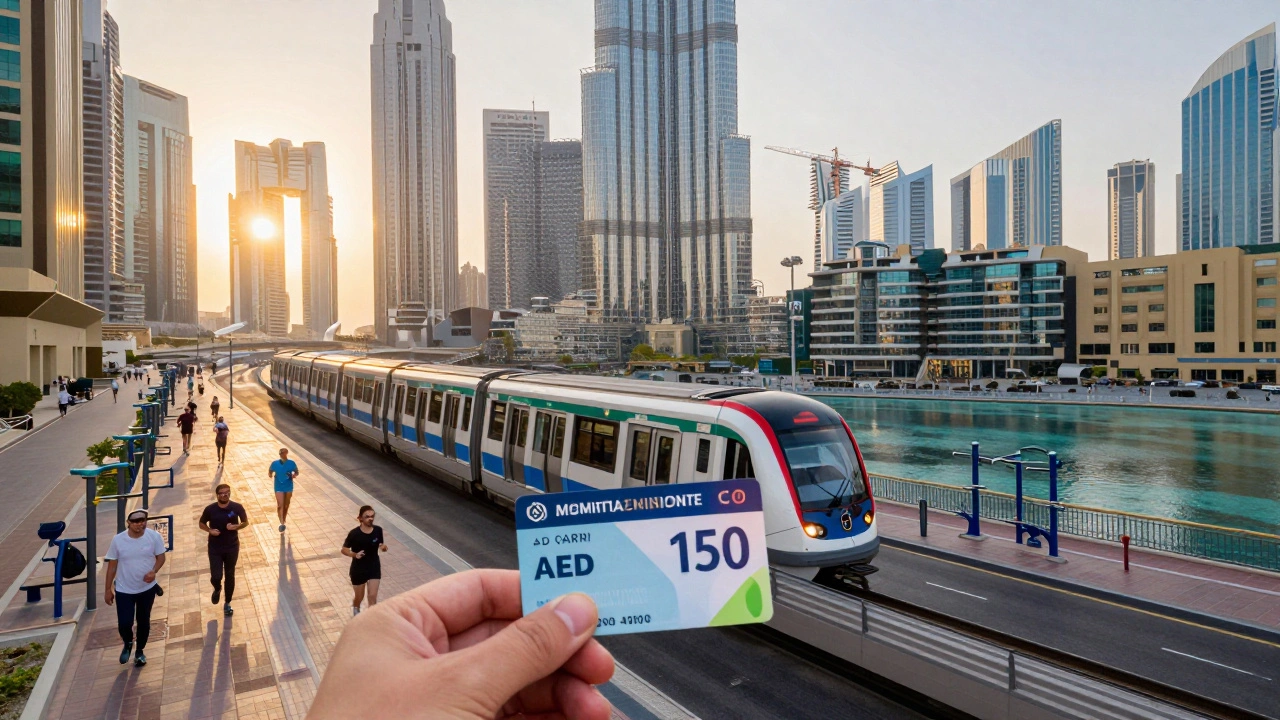
Forget Uber. Take the metro. A single ride on Dubai Metro costs AED 3-8 depending on distance. A monthly pass? AED 150. That’s less than $41. In London? That’s two weeks of travel. In New York? A monthly MetroCard is $127. Dubai’s metro is clean, air-conditioned, and connects every major area - from the airport to Dubai Mall, to Jumeirah, to the business district. Buses? Even cheaper. Taxis? Start at AED 3 for the flagfall. You can ride from Bur Dubai to Dubai Marina for under AED 30. Public transport here isn’t just affordable - it’s efficient.

Gym Memberships Are a Bargain
Here’s the truth: you don’t need a $150/month gym in Dubai. You can get a full-service gym with free weights, cardio machines, group classes, and a pool for AED 150-250/month. Chains like Anytime Fitness, Fitness First, and even boutique studios like CorePower offer monthly rates under $70. Compare that to $100-200 in the U.S. or UK. Some gyms even let you pay weekly. And if you want outdoor fitness? Dubai’s beaches and parks have free equipment. Walk along the JBR Walk or Dubai Creek and you’ll see people doing push-ups, pull-ups, and yoga - for free.
Water and Electricity? Heavily Subsidized
Here’s something most expats don’t realize: your utility bills are capped. A typical 2-bedroom apartment pays AED 200-300/month for water and electricity combined - even if you run AC 24/7. In Florida or Texas? That same usage would cost $300-500/month. Dubai subsidizes utilities because of its oil wealth. You’re not paying market rate - you’re paying a government-set rate. No surprise hikes. No seasonal surcharges. Just steady, predictable bills.
Car Insurance and Registration? Surprisingly Low
Buying a car in Dubai? Insurance starts at AED 1,000/year for a basic policy. Registration? AED 400-500 every year. In California? You’d pay over $1,000 just for insurance alone. Dubai’s insurance system is competitive because there are 20+ providers. You can get quotes online in minutes. And if you’re on a work visa, some companies even cover part of the cost. Add in cheap fuel and low parking fees (many malls offer 2-3 hours free), and owning a car here is one of the best value moves you can make.
Beauty and Personal Care? A Deal
Salons, barbers, nail jobs - all dirt cheap. A men’s haircut? AED 25. A full pedicure? AED 50. A facial at a spa? AED 120. Compare that to $60 for a haircut in New York or $80 for a pedicure in London. Why? Labor costs are lower, and competition is fierce. There are hundreds of beauty salons in Deira, Bur Dubai, and Satellite City. You can get a full-body wax, eyebrow threading, and a haircut all for under AED 150. And don’t even get me started on hair extensions - a full set of human hair extensions runs AED 300-600. In Europe? You’d pay $800-$1,200.
Fast Food Is Way Cheaper Than You Think
Yes, Dubai has fancy restaurants. But the everyday eats? Unbelievably cheap. A combo meal at McDonald’s? AED 18. A shawarma wrap with fries? AED 12. A full plate of biryani at a local joint? AED 15. A cup of Arabic coffee and a date pastry? AED 8. You can eat three meals a day for under AED 50 if you stick to local spots. Even in malls, food courts offer full meals for AED 20-30. No need to splurge on fine dining every night. Dubai’s food culture is built on value.
What’s Not Cheaper? The Exceptions
Let’s be real - not everything’s cheap. Imported alcohol? Expensive. Brand-name cosmetics? Same price as elsewhere. Designer clothing? Marked up in malls. Premium smartphones? No discount unless you buy during Ramadan or Dubai Shopping Festival. But here’s the key: you don’t need to buy those things. The real savings are in the daily stuff - the things you use every day. Fuel, food, transport, phone, gym, utilities - these are where you win.
Why Does Dubai Do This?
Dubai isn’t rich because of oil anymore. It’s rich because it’s built a system where expats can live comfortably on a middle-income salary. The government doesn’t tax income. It doesn’t tax most goods. It keeps utilities low. It invests in infrastructure. It doesn’t want you to leave. It wants you to stay, spend, and build a life here. That’s why prices for essentials are kept low - even if it means absorbing the cost. You’re not getting a discount. You’re getting a public service.
What to Do Next
If you just moved here: skip the imported snacks. Shop at Lulu. Get a local SIM. Use the metro. Join a gym. Fill up at the nearest petrol station. You’ll be amazed at how much you save - and how much more you can enjoy.
If you’re visiting: don’t just shop at the mall. Eat at a local dhaba. Ride the ferry across Dubai Creek. Grab a coffee from a kiosk. These are the real Dubai experiences - and they cost less than your coffee back home.
| Item | Dubai (AED) | U.S. Equivalent ($) |
|---|---|---|
| Gas (1 liter) | 3.30 | 0.90 |
| Monthly phone plan (unlimited) | 99 | 27 |
| Monthly gym membership | 150-250 | 40-70 |
| Electricity + water (2BR apt) | 200-300 | 55-80 |
| Public transport pass | 150 | 41 |
| McDonald’s combo | 18 | 5 |
| Men’s haircut | 25 | 7 |
Is everything in Dubai cheap?
No. Luxury goods, imported alcohol, high-end fashion, and premium electronics cost about the same as elsewhere. But the essentials - food, fuel, transport, phone plans, utilities - are significantly cheaper. Focus on those areas to save big.
Can I really live on $1,500 a month in Dubai?
Yes - if you’re smart. Rent for a studio in Deira or Discovery Gardens is around $600. Utilities: $60. Food: $300. Transport: $40. Gym: $70. That’s $1,070. You’ve got $430 left for entertainment, shopping, or savings. It’s tight, but doable. Most expats live on $2,000-$3,000 and still save.
Do I need a car in Dubai?
Not at all. The metro and buses cover 90% of what you need. But if you want flexibility - especially for weekend trips to the desert or mountains - owning a car is worth it. With cheap fuel and insurance, it’s one of the best value purchases you can make.
Where’s the best place to shop for groceries?
Lulu Hypermarket and Carrefour have the best prices for Western goods. For Indian, Pakistani, and Filipino products, head to Deira’s Spice Souk or Satwa. DMart (Indian chain) is the cheapest for rice, lentils, and spices.
Are there any hidden costs I should watch out for?
Yes. Some apartments charge extra for water usage beyond a limit. Parking in some areas costs AED 5-10/hour. International calls can add up if you don’t use WhatsApp. But none of these are dealbreakers - just things to be aware of.




kimberly r.
February 13, 2026 AT 04:01Okay, let’s be real - Dubai’s cheap groceries are only cheap if you’re okay with produce that’s been flown in from 12 different countries and sat in a warehouse for three weeks. I’ve bought tomatoes that looked like they were painted. The ‘fresh’ label is a joke. And don’t even get me started on the ‘affordable’ chicken - half the time it’s been re-frozen twice. You think you’re saving money? You’re just trading quality for price. I used to live in Houston - I paid more, but I knew what I was eating. Here? It’s a gamble. And yes, I’ve eaten my share of questionable biryani. I’m not saying it’s not cheap. I’m saying it’s cheap for a reason.
Also, the metro is clean? Sure. But try riding it during Ramadan when 80% of the passengers are exhausted, dehydrated, and yelling into their phones. It’s not ‘efficient’ - it’s a human zoo. And don’t tell me about the air conditioning. I once sat in a car AC for 45 minutes after the metro broke down. That’s efficiency? No. That’s luck.
And gas at $0.90? Yeah, right. The price drops when oil is low. When it spikes? They don’t tell you. I’ve seen prices jump 40% in a week. They don’t advertise that. They just say ‘cheap fuel’ and move on. It’s not a public service. It’s a temporary illusion.
Also, the gym memberships? They all have hidden fees. You sign up for $70. Then they ‘upgrade’ you to a ‘premium’ package. You decline. Suddenly your keycard stops working. ‘Oh, we thought you wanted the extra services.’ Classic. They’re not saving you money. They’re just making you feel like you are.
And don’t even get me started on the ‘subsidized utilities.’ That’s not generosity. That’s a trap. You think you’re getting a deal? Wait until you get a bill for ‘excess consumption’ because you ran the AC for 10 hours straight. The cap is a myth. They’ll find a way to charge you. I’ve been here five years. I’ve seen it. It’s not cheap. It’s carefully controlled.
And the phone plans? Unlimited? Sure. But the speed drops to 2G after 10GB. No one tells you that. You think you’re getting 5G? You’re getting ‘priority’ throttling. It’s marketing. Not value.
I’m not saying Dubai’s bad. I’m saying it’s a performance. And if you’re not careful, you’re paying for the show.
Also, why do I even care? Because I’ve watched too many expats get ripped off thinking they’re ‘smart.’ They’re not. They’re just naive. And I’m here to tell you the truth. You’re welcome.
Eva Stitnicka
February 14, 2026 AT 10:34The assertion that Dubai’s utilities are subsidized is technically accurate but misleading. The government does cap consumption thresholds for residential users, but the subsidy is not universal - it’s means-tested, and it applies only to Emiratis and long-term visa holders with approved residency status. Expats on standard work visas are subject to higher tariffs if their usage exceeds the threshold, which is often set below average consumption levels in a 2BR apartment with central AC. The $55–$80 estimate assumes optimal usage, not typical usage. Most expats pay closer to $120–$180 monthly during summer. The narrative ignores data from the Dubai Electricity and Water Authority’s own annual reports, which show a 37% increase in non-Emirati utility expenditures between 2020 and 2023. Cheap? Only if you’re conserving. Affordable? Only if you’re unaware.
ANN KENNEFICK
February 16, 2026 AT 06:13Y’ALL. I JUST MOVED HERE FROM CHICAGO AND I’M LIVING MY BEST LIFE. I’M NOT JUST SAVING - I’M THRIVING. LAST WEEK I GOT A FULL BODY WAX, A HAIRCUT, AND A BOWL OF BIRYANI FOR UNDER $15. I TOOK THE METRO TO THE MALL, ATE A MCDONALD’S COMBO FOR $5, AND THEN WENT TO THE GYM FOR $60 A MONTH. I’M NOT EVEN TRYING. I JUST SHOWED UP. AND NOW I’M DOING YOGA ON THE BEACH AT SUNRISE WITH A COFFEE THAT COSTS $2. I WASN’T EXPECTING THIS. I THOUGHT DUBAI WAS JUST SAND AND LUXURY CARS. BUT NO. IT’S A SECRET WORLD WHERE EVERYDAY LIFE IS A DEAL. I DIDN’T KNOW I COULD LIVE LIKE THIS. I DIDN’T KNOW I COULD EAT SO WELL FOR SO LITTLE. I’M NOT JUST DOING BETTER - I’M REINVENTING MYSELF. AND IF YOU’RE THINKING ABOUT COMING HERE? DO IT. DON’T OVERTHINK IT. JUST GET A SIM CARD, A METRO PASS, AND A LULU CARD. YOU’LL BE AMAZED AT HOW MUCH SPACE YOU HAVE - NOT JUST IN YOUR WALLET, BUT IN YOUR HEART. THIS PLACE? IT’S NOT JUST CHEAP. IT’S LIBERATING.
Also, I made a friend at the grocery store who gave me free dates. She said, ‘You look like you need sweetness.’ I cried. It’s not about money. It’s about connection. And Dubai? It gives that too.
Ibrahim Ibn Dawood
February 18, 2026 AT 04:27The claim regarding the affordability of mobile plans is misleading. While the advertised price of AED 99 per month is accurate, this rate is contingent upon a 24-month contract and a mandatory deposit of AED 500, which is refundable only upon termination. Moreover, the ‘unlimited’ data plan is subject to throttling after 20GB, rendering it functionally limited. Furthermore, the absence of contracts is inaccurate - most plans are auto-renewed with no explicit opt-out mechanism. The ease of purchasing a SIM card at Carrefour is also overstated; non-residents require a valid visa and passport, and many branches refuse service to tourists without an Emirates ID. The narrative omits these critical conditions, thereby presenting an incomplete picture of accessibility and cost.
Mia Peronilla
February 18, 2026 AT 23:15i just moved here last month and i swear i thought the gas was a typo when i saw 3.30 aed… like… is this a joke? but then i realized… maybe it’s not about the price… maybe it’s about how we’ve been conditioned to think ‘cheap’ means ‘bad’ and ‘expensive’ means ‘good’? like… why do we assume that if something is cheap, it’s a trap? what if… it’s just… simple? what if the system is built differently here? not because they’re ‘exploiting’ us… but because they’re not trying to profit off the daily grind? i don’t know. i’m just sitting here with my $10 watermelon and wondering if we’ve all been taught to distrust abundance? like… what if the truth is… we’re not used to things being this… easy? maybe that’s the real cost. not the money. but the mindset.
also i think i cried when i saw the price of a haircut. not because it was cheap. because i realized i’d been paying $80 for someone to ‘style’ me. here? they just cut it. and i felt… free. weird. i know. but yeah.
lady october
February 19, 2026 AT 07:07So let me get this straight - Dubai is ‘cheap’ because they’re flooding the market with imported goods, suppressing wages, and using oil money to hide the real cost? And you’re calling that ‘value’? That’s not a savings. That’s a subsidy built on exploitation. The workers who stock Lulu, drive the metro, clean the gyms - they’re paid $200 a month. You’re getting ‘cheap’ food because they’re living in tents. You think this is sustainable? It’s not. It’s a bubble. And when the oil runs out - or when the world stops buying it - you’ll be the one stuck with a $150 gym membership and a phone bill that’s suddenly $500 because ‘the subsidy’s been revoked.’ You’re not living smart. You’re living on borrowed time. And you’re too busy eating $5 biryani to notice the house is on fire. I’ve seen this movie. It ends badly. Don’t be fooled by shiny malls and low prices. This isn’t a bargain. It’s a trap wrapped in a discount.