
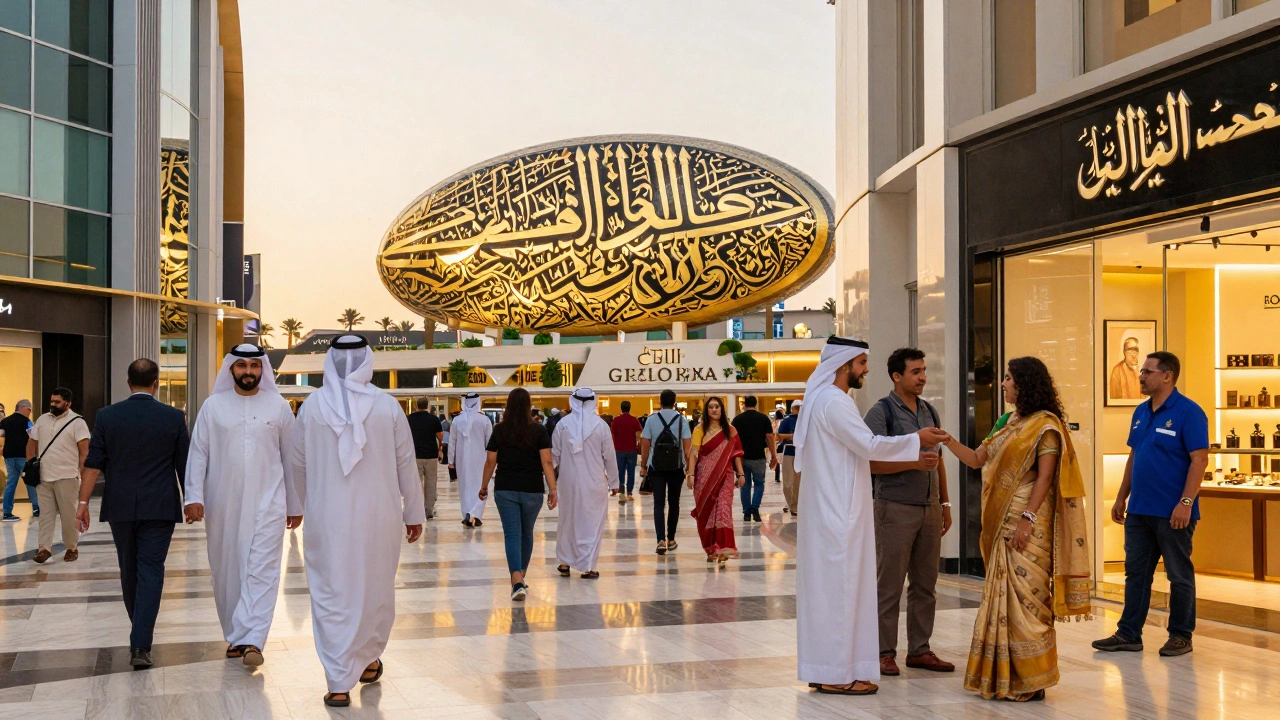
You’re walking through the Dubai Mall, sipping a cold drink, surrounded by signs in glittering gold script and flashing digital billboards. A shopkeeper greets you with a warm ‘Ahlan wa sahlan’. A taxi driver asks if you need help in perfect English. A child on the escalator shouts ‘Mama, look!’ in Hindi. You pause. What language do they speak in Dubai? It’s not one answer. It’s a whole symphony.
Quick Takeaways
- Dubai’s official language is Arabic, but English is the everyday language for most people.
- Over 200 nationalities live here-so you’ll hear Hindi, Urdu, Tagalog, Bengali, Farsi, and more on the streets.
- Signage, menus, and official documents are bilingual (Arabic and English).
- Most locals speak fluent English, but learning a few Arabic phrases goes a long way.
- Workplaces and schools mostly operate in English, especially in international businesses.
What’s the Official Language?
Arabic is the official language of the United Arab Emirates. That means government buildings, courts, official documents, and school curriculums use Modern Standard Arabic. But here’s the thing-no one walks around talking like a news anchor. In daily life, Emiratis speak Gulf Arabic, a dialect full of rhythm and warmth. It’s faster, softer, and full of local flavor. You’ll hear phrases like ‘Shu akhbarak?’ (How are you?) or ‘Insha’Allah’ (God willing) all day long.
But if you’re visiting or living here, you don’t need Arabic to get by. Not even close.
Why English Rules the Streets
Here’s the real story: Dubai is a global hub. Over 85% of its population is expat. That means most people you meet didn’t grow up speaking Arabic. They came from India, the Philippines, Pakistan, Egypt, Nigeria, the UK, the US-you name it. So what’s the common ground? English.
Think about it: your hotel staff? English. The guy at the gas station? English. The nurse at the hospital? English. The Uber driver? English. Even the Emirati parents in the playground? They’re often chatting in English with their kids, who grew up bilingual.
Signs? Bilingual. Menus? Bilingual. Metro maps? Bilingual. Even the Dubai Police app? Available in 12 languages, but English is the default.
English isn’t just common here-it’s the default. You could live here for five years and never learn a word of Arabic. You’d still be fine.
But What About Other Languages?
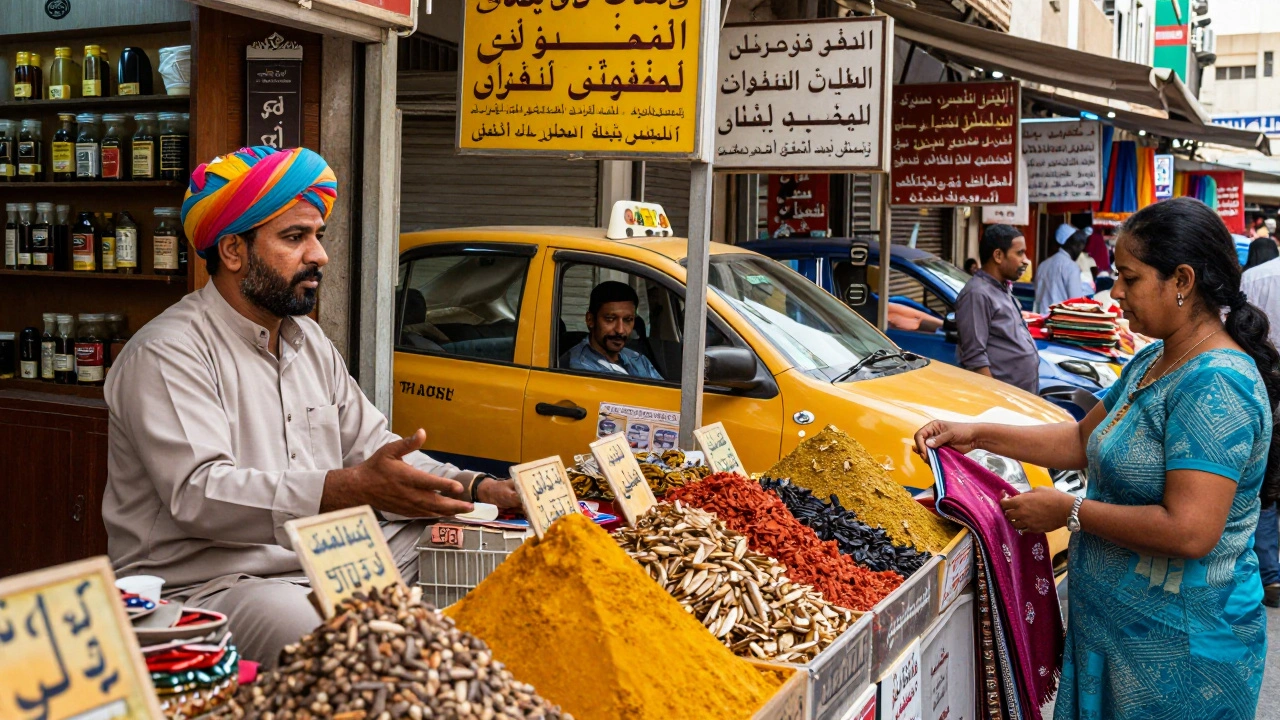
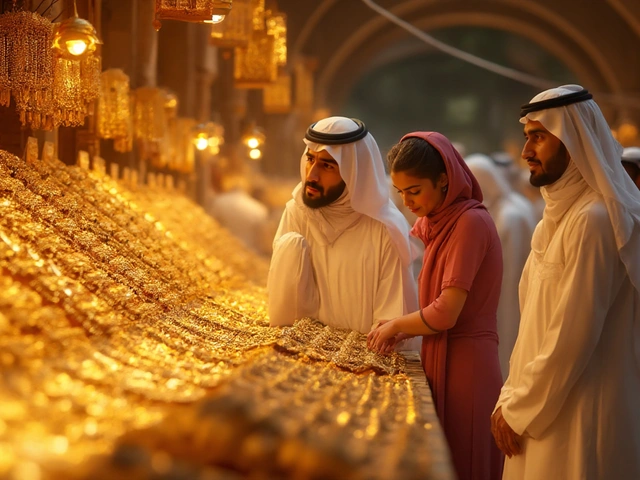
Here’s where it gets interesting. Walk into a supermarket in Deira, and you’ll hear Hindi being spoken at the spice counter. Ride the bus in Bur Dubai, and someone’s chatting in Tagalog. Head to the Gold Souk, and you’ll catch Urdu, Farsi, and even Russian.
Why? Because Dubai’s workforce is built on global migration. Indian workers make up the largest group-over 3 million people. That’s more than the entire population of Ireland. Filipino domestic helpers, Pakistani drivers, Egyptian chefs, Nepali construction workers-they all bring their languages with them.
So while Arabic and English are the two pillars, the city’s real linguistic texture comes from the other 100+ languages spoken daily. You’ll hear Tamil on the construction site, Bengali in the grocery store, and Chinese in the electronics shops of Sharaf DG.
Can You Get By With Only English?
Yes. Absolutely.
Every restaurant, hotel, mall, and tourist attraction in Dubai operates in English. Even the smallest family-run shawarma joint in Al Quoz has an English menu. The metro has English announcements. The airport signs? English first. If you’re lost, ask anyone-chances are they’ll respond in perfect English, no matter their nationality.
But here’s a pro tip: learning just three Arabic phrases can change how people treat you. Say ‘Shukran’ (thank you), ‘Min fadlak’ (please), and ‘Kayf halak?’ (How are you?)-and suddenly, you’re not just another tourist. You’re someone who tried. That’s the magic of Dubai. People notice effort.
How Language Shapes Daily Life
Language here isn’t just about words-it’s about identity, respect, and belonging.
At work, international companies use English as their official language. Meetings, emails, contracts-all in English. But if you’re in a government job or working with local authorities, Arabic is required. Even then, most officials will switch to English if you’re not fluent.
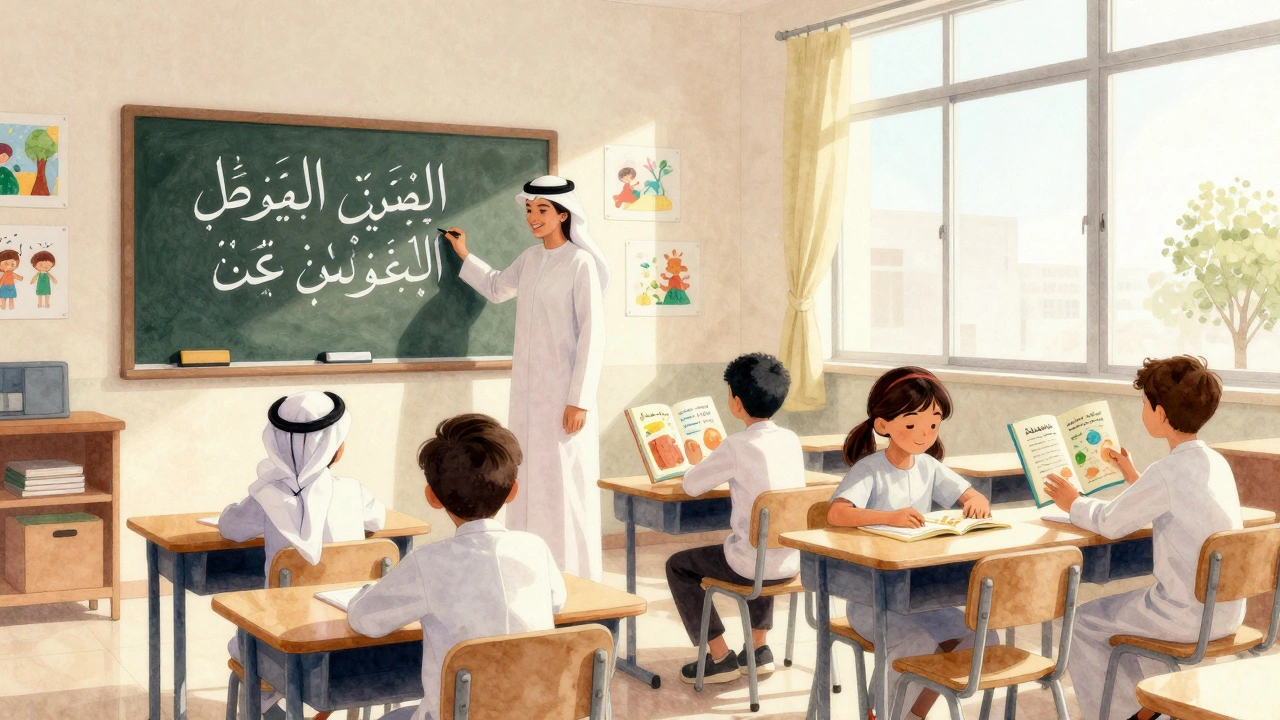
At school, Emirati children learn Arabic as their mother tongue, but English is taught from kindergarten. By high school, most are fluent in both. Private international schools? English-only, with Arabic as a subject.
And in the home? It’s mixed. Many Emirati families speak Arabic at home, but their kids reply in English. It’s normal. It’s the new Dubai.
What About Signs and Public Info?
Everything you see in public is bilingual. Bus stops, hospital signs, airport terminals, even the toilet doors in the metro-all have Arabic and English. Some newer buildings add a third language: Urdu or Hindi, just to make things easier for the biggest expat groups.
And if you’re using a smartphone app? Google Maps, RTA app, or even the Dubai Culture app? All have English as the default. You can switch to Arabic, but you don’t have to.
Do Locals Speak English Fluently?
Yes. Most do. Especially those under 40. Many Emiratis studied abroad-in the UK, the US, Australia. Others went to international schools here. English isn’t just a skill-it’s a passport.
Don’t expect everyone to sound like a BBC presenter. Accents vary. Some speak with a slight Indian lilt. Others have a Gulf drawl. But clarity? Always there. You won’t be misunderstood.
And if you’re nervous about speaking? Don’t be. Emiratis are famously hospitable. They’ll slow down, repeat, or even switch to Arabic if they think you’re struggling. They want you to feel welcome.
What If You Want to Learn Arabic?
If you’re curious, Dubai makes it easy. There are free Arabic classes offered by the Dubai Culture Authority. Private tutors cost around AED 100-150 per hour. Apps like Duolingo and Memrise have Gulf Arabic courses now. And if you’re serious, the American University of Dubai offers short-term language certificates.
But here’s the truth: you don’t need to become fluent. Just knowing how to say hello, thank you, and sorry goes further than you think. Locals appreciate it. And honestly? It makes your coffee taste better.
Language in Dubai vs. Other Gulf Cities
Compare Dubai to Riyadh or Muscat. In Saudi Arabia, Arabic dominates public life. English is common in business, but less so on the street. In Oman, Arabic is stronger too. But Dubai? It’s different. It was built for global trade, not just regional culture.
That’s why Dubai feels more like Singapore than Jeddah. English isn’t a second language here-it’s the operating system.
FAQ: Your Questions About Language in Dubai Answered
Do I need to learn Arabic to live in Dubai?
No. English is enough for daily life-shopping, work, transport, healthcare. But learning basic Arabic phrases shows respect and makes interactions more meaningful. Locals notice, and they appreciate it.
Is English spoken in government offices?
It depends. Official documents are in Arabic, but most staff in tourist-facing offices (like visa centers or tourist police) speak English. If you’re dealing with legal or bureaucratic matters, bring a translator or ask for help-many offices offer translation services.
Can I use Hindi or Urdu in Dubai?
Absolutely. Hindi and Urdu are widely spoken in markets, workplaces, and neighborhoods like Bur Dubai and Deira. You’ll find shops, restaurants, and even community centers that operate entirely in these languages. Many Emiratis understand basic phrases too.
Are there language barriers for tourists?
Very few. Dubai is designed for international visitors. Everything from metro signs to hotel reception desks is bilingual. Even in smaller shops, staff usually speak at least basic English. You’re unlikely to face a real language barrier.
What language do children speak in Dubai schools?
In public schools, Emirati children learn Arabic as their main language, with English as a core subject. In private international schools, English is the primary language of instruction. Many kids grow up speaking both, plus a third language from home-like Urdu, Tagalog, or Russian.
Final Thought: Language Is the Heartbeat of Dubai
Dubai doesn’t have one language. It has dozens-and that’s its strength. The city doesn’t ask you to become someone else. It welcomes you as you are. Speak English? Perfect. Try Arabic? Even better. Speak Hindi, Tagalog, or Farsi? You’re already part of the rhythm.
So when you ask, What language do they speak in Dubai?-the real answer is: whoever you are, you’ll be understood here.


Dan Helmick
December 8, 2025 AT 03:52So Dubai’s linguistic chaos is just capitalism wearing a thobe, isn’t it? They didn’t build a city-they built a linguistic Airbnb. Arabic for the paperwork, English for the profit, and every other language for the laborers who keep the lights on while the expats take selfies with camels. I love how they call it ‘multiculturalism’ when it’s really just linguistic colonialism with better AC. You don’t need to learn Arabic? Of course not. Why would you? The locals already speak your language-fluently, politely, and while working 12-hour shifts so you can order a $14 matcha latte. The real question isn’t what language they speak-it’s who gets to decide which one matters.
And don’t get me started on ‘Shukran’ being the magic phrase. That’s not cultural appreciation, that’s performative tourism. You say ‘Shukran’ and think you’re a hero? Nah. You’re just the guy who didn’t step on the carpet. The real respect? Pay the guy who cleans your hotel room more than $3 an hour. But hey, at least your Instagram story looks diverse.
Meanwhile, the kid on the escalator shouting ‘Mama, look!’ in Hindi? That’s the real heartbeat. Not the gold-plated mall signs. Not the bilingual metro announcements. That kid’s mom probably speaks five languages and still has to show her passport every time she breathes too loudly. But sure, let’s romanticize the ‘symphony.’ The symphony’s got a damn invoice attached to every note.
I’m not saying Dubai’s bad. I’m saying it’s brilliant. And deeply, painfully, beautifully exploitative. Like a five-star hotel where the staff are ghosts with visas.
And yet-I still want to visit. Because even a machine built on inequality can still make a damn good shawarma.
Also, ‘Insha’Allah’ is the most honest phrase in the English language. It means ‘maybe’ but sounds like divine intervention. We should adopt it everywhere. Especially when our Uber is 47 minutes late.
Anyway. I’m done. For now. Probably.
Still. Someone needs to write a book called ‘The Linguistics of Exploitation: How Dubai Turned Multilingualism Into a Business Model.’ I’ll buy it. I’ll read it. I’ll post a photo of it with my Dubai skyline filter. And then I’ll go back to pretending I’m not part of the machine.
Juhi Edwin
December 9, 2025 AT 07:51I’ve lived here for 8 years and honestly, the language thing is just… normal. You don’t think about it until you leave. I work in a hospital and my coworkers speak Tagalog, Urdu, Arabic, and English-all in the same shift. I’ve learned to pick up phrases from everyone. ‘Kamusta?’ ‘Shukran.’ ‘Salaam.’ ‘How you doing?’ It’s just how we talk. No one’s trying to be fancy. We’re just trying to get through the day.
And yeah, English is the glue. But the real magic? When the nurse who speaks only Bengali smiles at a patient and says ‘Aami tomar jonno bhalobashi’-I love you for you-and the patient, who’s from Germany, understands anyway. That’s the language here. Not words. Care.
Also, the guy who runs the shawarma stand? He speaks Arabic, Hindi, and broken Russian. He taught me how to say ‘more sauce’ in all three. I still use it. It’s my thing now.
Dubai doesn’t need you to learn Arabic. It needs you to be kind. And if you’re kind, the language finds you.
jasmine zeindler
December 10, 2025 AT 16:11OMG. I’m literally crying. This is SOOOO profound. 😭✨ Like, I just flew in from Paris and the *aesthetic* of the bilingual signage? *Chef’s kiss.* 💋 And the way the Emiratis just *glide* through English with that soft Gulf accent? So. Elegant. I’m taking a course in Gulf Arabic next month-obviously. Chanel just launched a limited-edition ‘Shukran’ clutch. It’s gold. Of course it is. 💫
Also, I met this *adorable* Filipino nanny who spoke *zero* English and I was like, ‘Aww, how quaint!’ and she just smiled and handed me a samosa. I’m writing a memoir. Title: ‘Dubai: Where My Soul Found Its Accent.’ 🌍📖
PS: If you don’t know at least three Arabic phrases, you’re basically a barbarian. Just saying. 💅
Michelle Avendano
December 10, 2025 AT 16:42Elizabeth Guice
December 12, 2025 AT 07:32Let me tell you something about Dubai that no one writes about: language here isn’t a tool-it’s a living, breathing tapestry woven by people who left everything behind just to be heard.
That woman selling dates in the Gold Souk? She speaks Arabic at home, Urdu with her husband, Hindi with her coworkers, English with tourists, and a little French from the years she spent in Lyon. She doesn’t ‘code-switch.’ She *lives* in the spaces between.
And yes, English is the lingua franca-but it’s not the *soul*. The soul is in the way the Nepali construction worker hums a folk song in his native tongue while fixing the AC. The soul is in the Pakistani driver who says ‘Insha’Allah’ like it’s a prayer and a promise. The soul is in the Filipino maid who teaches her employer’s toddler to say ‘Tita’ instead of ‘Auntie’ because it sounds more like home.
Dubai doesn’t have one language because it doesn’t have one story. It has 200. And every single one of them is worth listening to-not because it’s exotic, but because it’s human.
And you know what? The people who say ‘just learn Arabic’? They’ve never stood in a 40°C heat at 6 a.m. watching a Bangladeshi man carry a stack of boxes while his kid sleeps on his shoulder. They’ve never heard him whisper ‘Ami bhalo achi’-I am fine-when he’s clearly not.
So don’t just say ‘Shukran.’ Say ‘I see you.’
That’s the real language of Dubai.
And if you don’t believe me? Go to the airport at 2 a.m. Listen. Just listen. You’ll hear the whole world breathing.
And you’ll realize-you’re not a visitor.
You’re just late to the party.
Thandi Mothupi
December 14, 2025 AT 03:54