
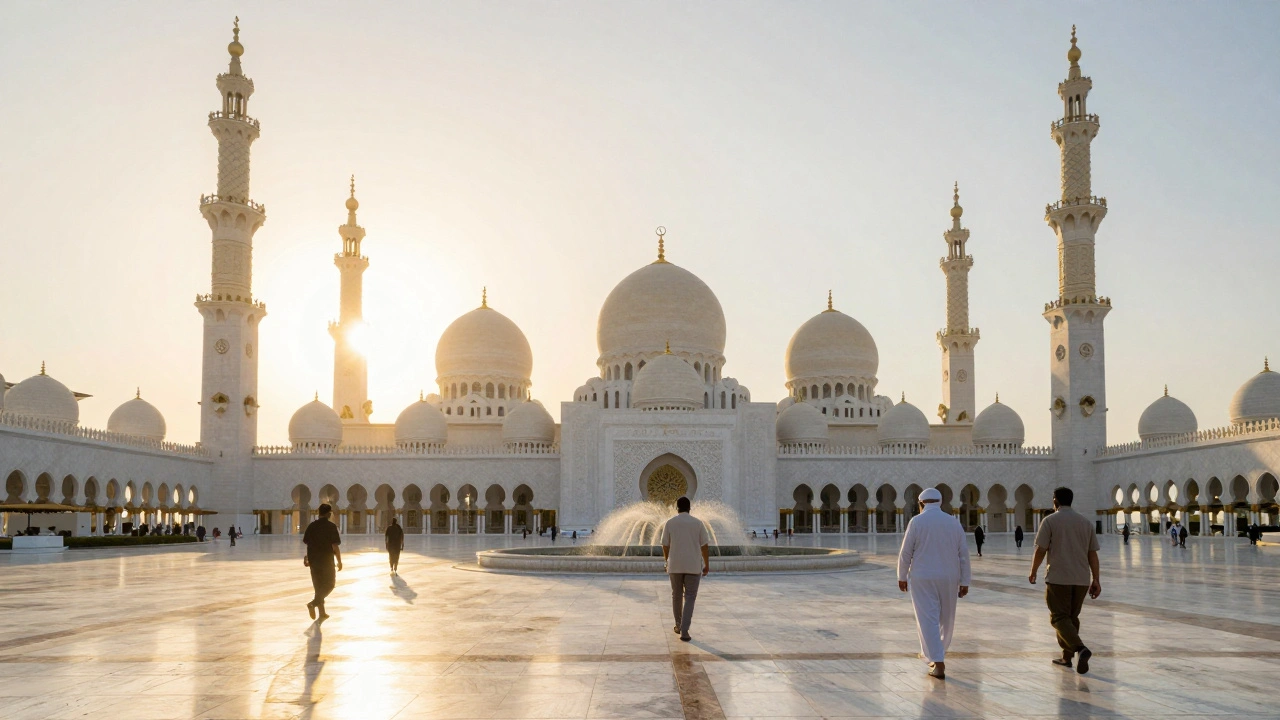
You’ve seen the photos: white domes glowing under the Dubai sun, minarets piercing the sky, crowds of visitors quietly walking through the courtyards. But have you ever stopped to wonder what’s really happening inside the Jumeirah Mosque? It’s not just a postcard. It’s a living heartbeat of faith, culture, and history that shaped modern Dubai.
What Makes Jumeirah Mosque Different?
Most mosques in Dubai are closed to non-Muslims. Not Jumeirah. This is one of the very few in the city that opens its doors to visitors from every background. Built in 1979, it wasn’t designed just to serve worshippers-it was built to teach. The architects used traditional Fatimid and Mamluk styles, with intricate carvings, hand-painted tiles, and arches that echo centuries-old craftsmanship from Egypt and Syria. The mosque’s two domes and four minarets aren’t just decorative-they’re a visual language of Islamic art, meant to inspire awe and reflection.
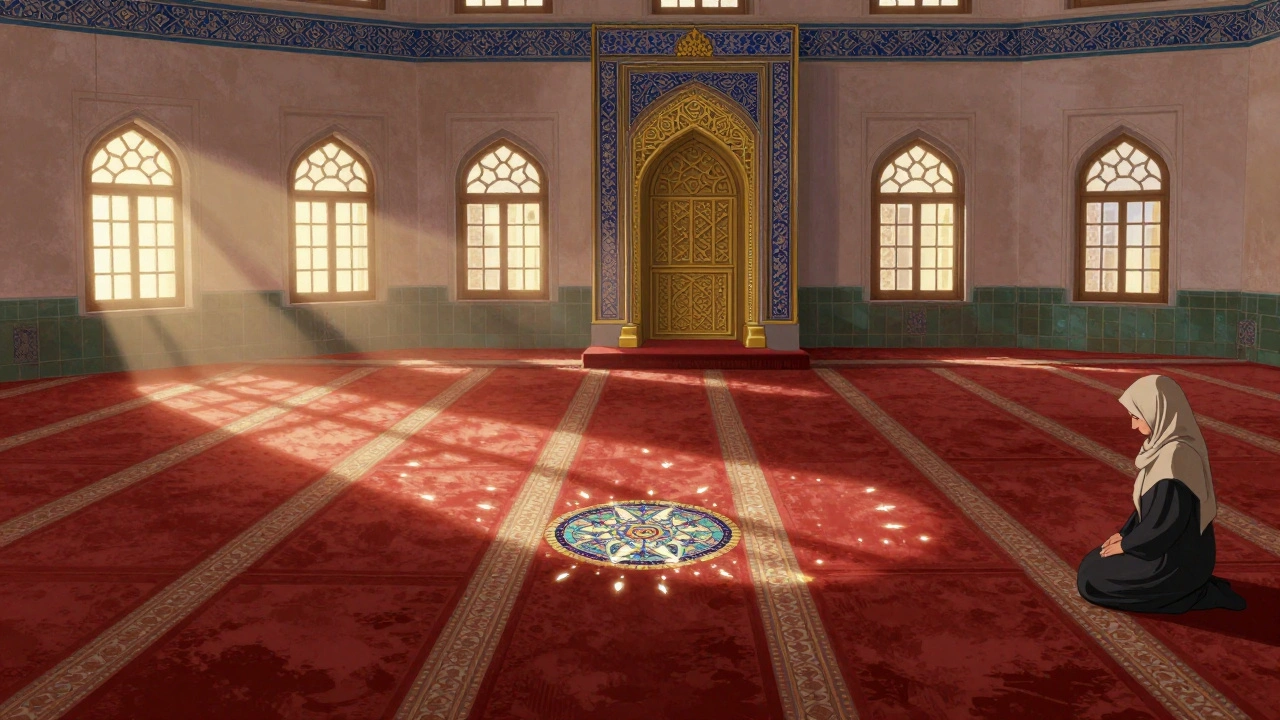
What you won’t see on Instagram: the quiet morning prayers, the scent of oud drifting from the women’s prayer area, the way sunlight hits the mosaic tiles at exactly 10:15 a.m., turning the floor into a shimmering map of stars and geometry. This isn’t a museum. It’s a place where faith still breathes.
Why It Matters to Dubai’s Identity
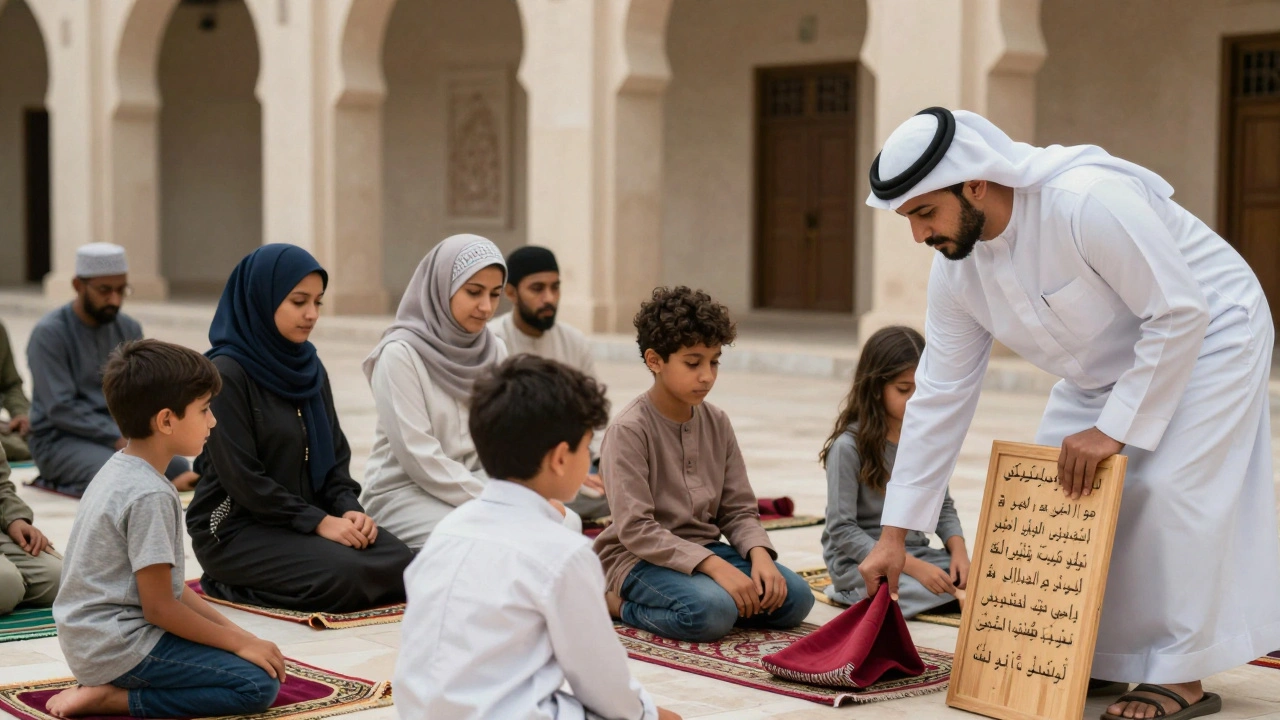
Dubai grew fast. Skyscrapers rose. Desert turned into shopping malls. But Jumeirah Mosque stood still-not because it was forgotten, but because it was needed. In a city that’s 85% expatriate, this mosque became a bridge. Tourists come here to understand Islam beyond headlines. Local families bring their children to learn how prayer rugs are folded, why water is used before prayer, and what the call to prayer really sounds like-no filters, no edits.
It’s also a symbol of tolerance. In 2024, over 1.2 million visitors took part in guided tours organized by the Dubai Islamic Affairs and Charitable Activities Department. That’s more than the population of many countries. People from Japan, Brazil, Poland, and Nigeria have walked these halls, asked questions, and left with a deeper understanding of a faith they once only saw on TV.
What You’ll See Inside
Step through the main entrance, and you’re greeted by a courtyard paved with white marble, cool under bare feet. To your left, a fountain where visitors perform ablutions before entering. To your right, a small museum with ancient Qurans, prayer beads from the 1800s, and a replica of the Prophet Muhammad’s sandals-carefully preserved, never touched by visitors.
The prayer hall is the heart. No chairs. No pews. Just endless rows of red carpets stretching toward the qibla wall, where a single mihrab-niche carved with gold leaf-points toward Mecca. The ceiling? A masterpiece of geometric patterns, each shape repeating in perfect symmetry. That’s not just art. It’s a reminder: in Islam, unity comes from order, repetition, and balance.
And yes, you can sit. Not to pray, but to observe. There are benches near the back, shaded by arches, where you can watch how women pray separately, how men bow in unison, how children are gently guided to kneel without being scolded. This isn’t performance. It’s practice. And it’s beautiful.
How the Mosque Teaches Without Preaching
There are no loudspeakers telling you what to believe. Instead, there are quiet signs. A wooden board near the entrance explains the five pillars of Islam in simple English, Arabic, and Urdu. A display case shows how Ramadan is observed in Dubai-dates, lanterns, charity boxes. A video loop in the visitor center plays interviews with Emirati women who wear the hijab-not as a symbol of oppression, but as a personal choice rooted in dignity.
The guides? They’re not hired actors. They’re volunteers: students, retirees, teachers. Many are expats who moved here years ago and fell in love with the culture. One woman from Canada told me she came on a whim in 2019 and now leads tours every Saturday. “I didn’t know Islam,” she said. “Now I teach it.”
Visiting Jumeirah Mosque: What You Need to Know
You don’t need to be Muslim to visit. But you do need to respect the space. Here’s how:
- Dress modestly. Women: cover shoulders and knees. Scarves are provided at the entrance if you don’t have one. Men: no shorts. Long pants only.
- Remove your shoes. You’ll leave them in cubbies. No exceptions.
- Visit during daylight hours. Tours run daily from 9 a.m. to 4 p.m., except Friday, when the mosque is reserved for prayer.
- Don’t take photos during prayer. The mosque has a photo zone near the courtyard. Use it.
- Ask questions. The guides are happy to explain. No question is too simple.
The best time to go? Weekday mornings. The crowds are thin, the light is soft, and you’ll have space to sit and just… be.
What You Won’t Find Here
No gift shops selling “Islamic” keychains. No cafes selling overpriced dates. No selfie sticks. No loud music. No vendors pushing souvenirs. This isn’t a tourist trap. It’s a sanctuary.
Even the mosque’s architecture avoids flashy modernity. No glass towers. No LED lights. Just stone, plaster, and light. It’s a quiet rebellion against the noise of Dubai. A reminder that beauty doesn’t need to shout.
How It Compares to Other Mosques in Dubai
| Feature | Jumeirah Mosque | Sheikh Zayed Grand Mosque (Abu Dhabi) | Al Farooq Omar Bin Al Khattab Mosque (Dubai) |
|---|---|---|---|
| Open to non-Muslims | Yes, daily tours | Yes, but limited hours | No |
| Architectural style | Fatimid/Mamluk | Modern Islamic | Contemporary Emirati |
| Capacity | 1,200 worshippers | 40,000 | 15,000 |
| Guided tours | Free, daily | Free, scheduled | No |
| Visitor count (2024) | 1.2 million | 4.8 million | Not open |
Jumeirah isn’t the biggest. It’s not the shiniest. But it’s the most accessible. And that’s what makes it powerful.
Frequently Asked Questions
Can I visit Jumeirah Mosque on Friday?
No. Friday is the main day of prayer for Muslims, and the mosque is closed to visitors during this time. The last tour ends at 1 p.m. on Thursday, and it reopens at 9 a.m. on Saturday. Plan ahead.
Do I need to book a tour in advance?
No. Walk-ins are welcome. But if you’re coming with a group of 10 or more, it’s smart to call ahead. The mosque can accommodate up to 50 visitors per hour. Arriving early-before 10 a.m.-means shorter waits and more space to explore.
Are children allowed?
Yes. Kids of all ages are welcome. Many families bring their children to teach them about different cultures. The guides often have simple stories or games to help younger visitors understand what they’re seeing.
Is there a fee to enter?
No. Entry and guided tours are completely free. Donations are accepted, but never required. The mosque is funded by the Dubai government and private donors who believe in cultural exchange.
Can I pray at Jumeirah Mosque if I’m not Muslim?
No. The prayer areas are reserved for practicing Muslims. But you’re welcome to sit quietly in the courtyard or visitor area during prayer times. Many visitors find it peaceful to sit and listen to the call to prayer-it’s not a performance. It’s a song.
What to Do After Your Visit
Leave with more than photos. Leave with questions. Maybe you’ll wonder why prayer mats are always the same size. Or why the mosque has no idols. Or how a city built on oil became a home for such deep spiritual traditions.
Walk to the nearby Jumeirah Beach. Sit on the sand. Look back at the mosque. It’s still there. Quiet. Unchanged. Still welcoming. That’s the real magic-not the domes, not the tiles, but the fact that in a city of 8 million people, this one place still says: You are welcome here.

Tim Orrell
February 14, 2026 AT 22:48The Jumeirah Mosque isn't just architecture it's epistemological infrastructure
Every geometric pattern a recursive affirmation of tawhid
Every ablution fountain a ritualized purification of the Cartesian ego
The absence of idols isn't absence it's hyperpresence of the ineffable
You don't visit this space you enter a phenomenological bracket where meaning isn't conveyed it's enacted
The guides aren't interpreters they're hermeneutic conduits
And that silence between calls to prayer? That's the sound of ontological humility
Modern Dubai built skyscrapers to touch heaven
This mosque built silence to remind you heaven doesn't need touching
Clay Caldwell
February 15, 2026 AT 04:15I went last month after reading this. Sat in the courtyard for 45 minutes just watching. No phone. No notes. Just listening to the echo of footsteps on marble. The light at 10:15 AM was like watching time crystallize. No one spoke. No one needed to. That’s the real miracle here-not the tiles or the domes, but how a place can make 8 million people feel like they’re alone together.
Nithin Kumar
February 16, 2026 AT 05:37Sarah Fleming
February 17, 2026 AT 21:24It's fascinating-truly, profoundly fascinating-that a structure so steeped in centuries-old tradition can function, with such seamless grace, as a contemporary vessel for intercultural dialogue… isn't it? And yet, one must wonder-is this accessibility a genuine bridge, or merely a performative gesture, carefully curated for global optics? The absence of gift shops… yes… but what about the absence of authentic, unmediated spiritual vulnerability? Are we, as visitors, truly invited… or merely observed?
Grace Shiach
February 19, 2026 AT 20:30Free tours. No pressure. No sales. Just quiet. That’s rare. Respect.
Elizabeth Guice
February 19, 2026 AT 22:25Let me tell you what no one says in the brochures
The real power of Jumeirah isn’t in its domes-it’s in the way a five-year-old girl from Nebraska, barefoot and wide-eyed, touches the edge of a prayer rug and doesn’t get shushed
It’s in the Polish grandmother who weeps silently because the call to prayer sounds like her late husband’s voice
It’s in the Brazilian engineer who realizes, for the first time, that faith doesn’t need to be loud to be true
And it’s in the Canadian woman who came for a photo and stayed to become a guide-not because she was asked, but because her soul finally found a language it recognized
This mosque doesn’t teach Islam
It teaches how to be human in a world that forgot how
It doesn’t open its doors to tourists
It opens its heart to strangers
And that? That’s the most radical act of peace left on Earth