
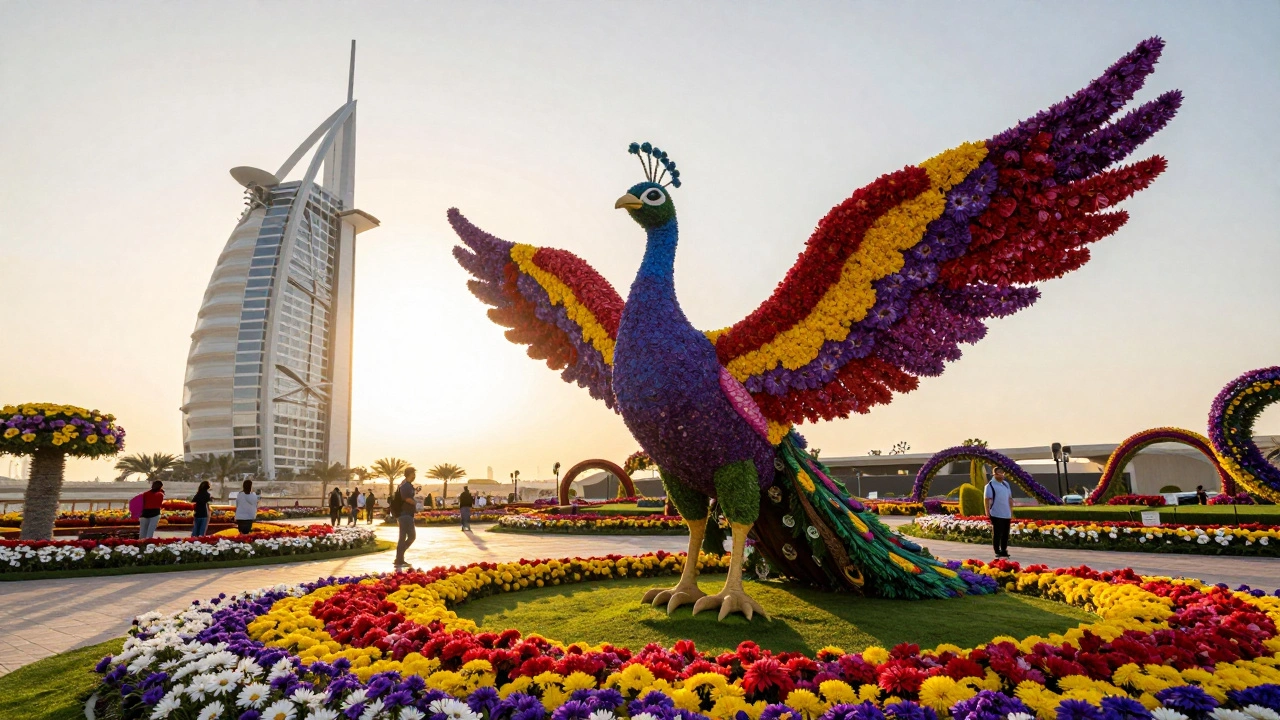
You’ve seen photos. Maybe even scrolled past them on Instagram. A castle made of tulips. A giant umbrella blooming with 20,000 roses. A 12-meter-tall peacock, wings spread, each feather a single petal. And you thought, Dubai Miracle Garden must be fake. But it’s real. And it’s bigger than anything you’ve ever imagined.
What Makes Dubai Miracle Garden So Unbelievable?
Let’s cut to the chase: Dubai Miracle Garden is the world’s largest natural flower garden. Not just big. Not just colorful. It holds the Guinness World Record for the most flowers used in a garden - over 150 million. That’s not a typo. 150 MILLION. And they’re all real. Planted by hand. Watered daily. Changed seasonally. This isn’t a theme park with plastic flowers. This is nature, turned into art, on a scale no one thought possible.
Opened in 2013, the garden sits in the heart of Dubai’s Al Barsha neighborhood, right off the main highway. It’s not hidden. It’s not tucked away. It’s built to be seen. And it’s open only during the cooler months - from late October to early May. Why? Because Dubai’s summer heat would kill even the toughest blooms. So, if you’re planning a visit, timing matters. March? Perfect. You’ll see roses, marigolds, petunias, and daisies in full, riotous color.
What You’ll Actually See (No Fluff)
Walking through Dubai Miracle Garden feels like stepping into a dream. You don’t just walk - you explore. Here’s what you’ll actually find:
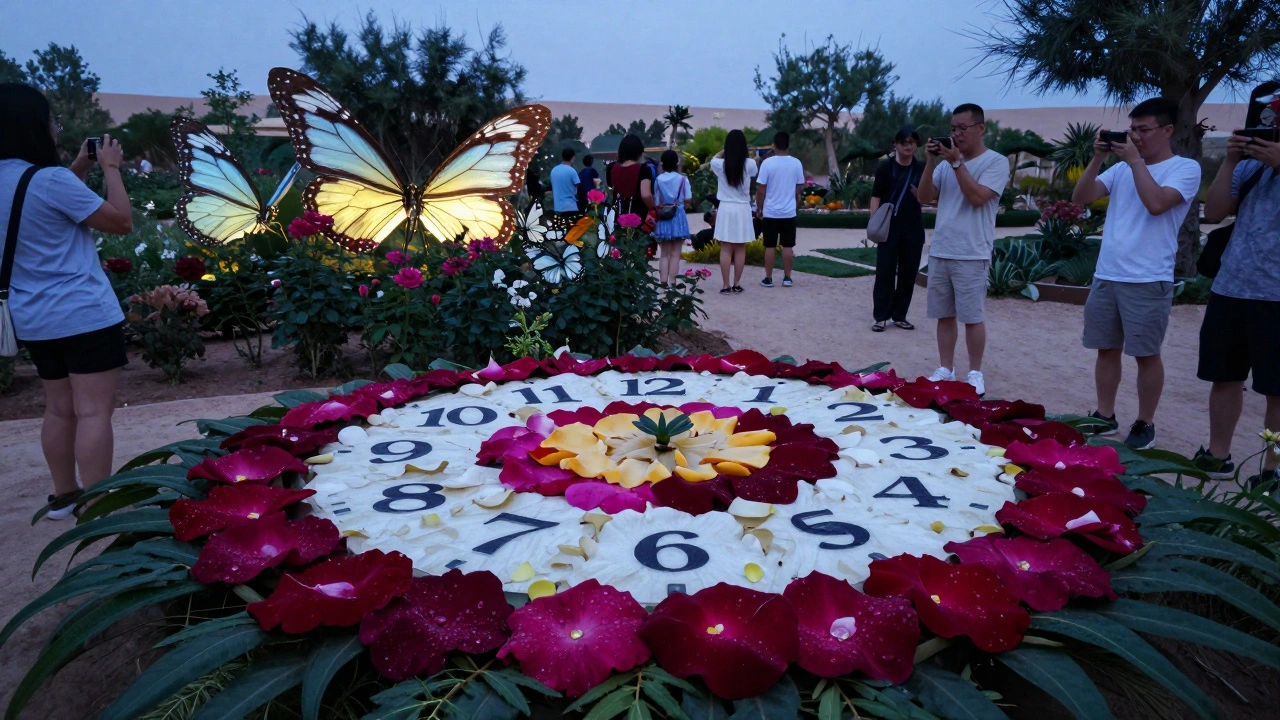
- The Butterfly Garden: Over 15,000 live butterflies fluttering around you. It’s not a cage. It’s an open-air habitat where you can stand still and feel them land on your shoulder. No photos can capture how quiet and magical it feels.
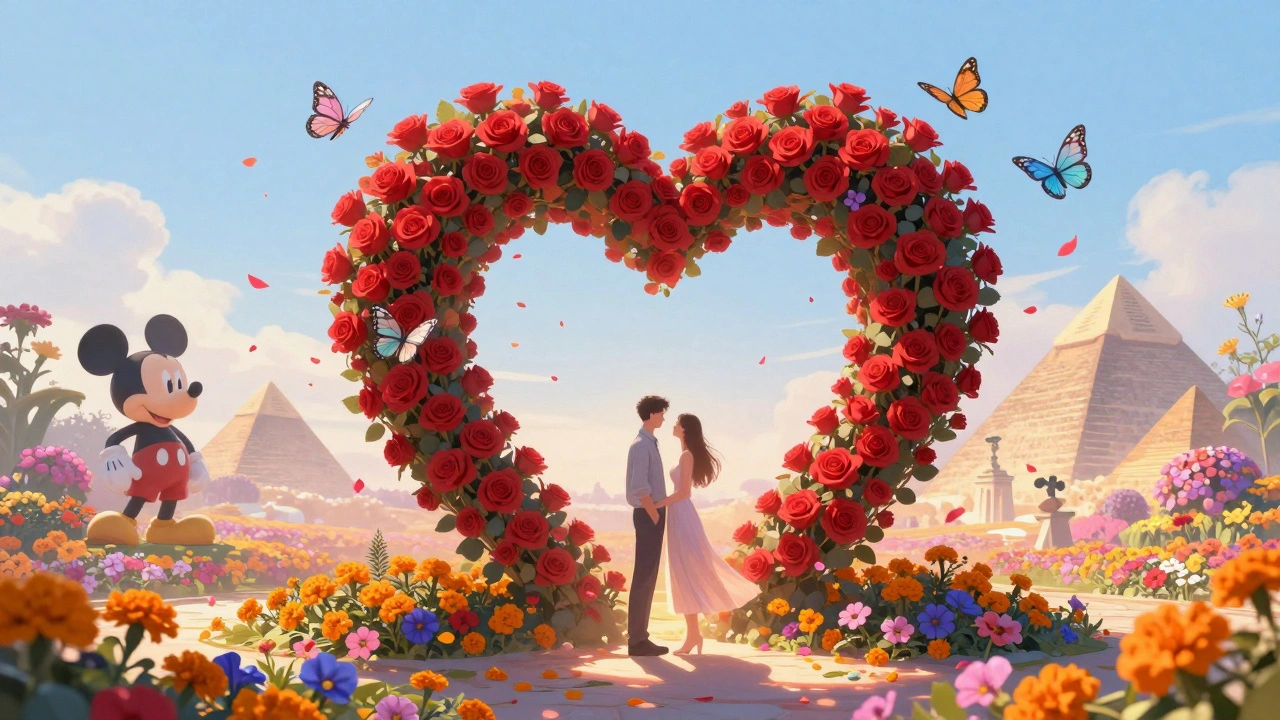
- The Heart-shaped Arch: Made of 100,000 red roses. It’s the most photographed spot for couples. And yes - people propose here. All the time.
- The Disney Characters Section: Mickey Mouse, Elsa, Spider-Man - all sculpted from flowers. Kids gasp. Adults smile. It’s pure joy.
- The Egyptian Pyramids: Built from 2 million flowers. The detail is insane. You can see individual petals forming the texture of stone.
- The Dubai Marina Tower: A 15-meter-tall replica of the real building, made entirely of daisies and chrysanthemums. It looks like it could be real… until you notice the petals moving in the breeze.
- The Flower Clock: A working clock, with flower petals shifting positions every hour. It’s not just decorative - it tells time.
There are over 120 themed areas. You could spend a full day here and still miss half. That’s the point. This isn’t a place you rush through. It’s a place you wander. Slow down. Look up. Bend down. Touch a petal. Smell the roses. It’s designed to make you forget you’re in a desert.
Why This Garden Exists (And Why It Matters)
Dubai doesn’t grow flowers naturally. The soil is sand. The sun burns. Rain is rare. So why build a garden like this?
It’s a statement. A bold one. Dubai took something impossible - a lush, blooming garden in the middle of the desert - and made it real. Using advanced irrigation, climate-controlled greenhouses, and soil engineering, they created a place where nature thrives against all odds. It’s not just pretty. It’s a feat of engineering.
And it works. Over 3 million visitors came in 2024. That’s more than the population of some countries. People fly here just to see this garden. It’s not a side attraction. It’s a headline. A must-see.
When to Go (And How to Avoid Crowds)
You don’t want to show up on a Friday afternoon and be stuck in a sea of selfie sticks. Here’s how to beat the rush:
- Best Days: Tuesday and Wednesday. Fewer tourists. Cooler temps. Better photos.
- Best Time: Arrive at opening (9 a.m.). The light is soft. The flowers are fresh. The crowds are thin.
- Avoid: Weekends, holidays, and Ramadan evenings. The garden gets packed.
- Pro Tip: Visit during sunset. The golden hour turns the garden into a painting. And yes - the lights turn on after dark. It’s a whole different experience.
How Much Does It Cost?
Entry is simple:
- Adults: AED 45 (about $12)
- Children (3-12): AED 30 (about $8)
- Under 3: Free
- Senior Citizens (60+): AED 30
That’s it. No hidden fees. No ticket bundles. You pay once, and you get unlimited access for the whole day. Parking is free. Water stations are free. Restrooms? Clean and well-maintained. This isn’t a money grab. It’s a gift.
What to Bring (And What to Leave Behind)
Here’s what actually works:
- Bring: Sunscreen, a hat, comfortable walking shoes, a light jacket (evenings get cool), a refillable water bottle, and a camera with a good zoom.
- Leave: Heels, bulky bags, and food. No picnics allowed. There are food stalls inside - cheap, tasty shawarma, juices, and ice cream.
- Pro Tip: Wear light colors. Dark clothes attract heat. And yes - people do take photos in white dresses. It makes the flowers pop.
Dubai Miracle Garden vs. Other Flower Gardens
Is it really the best? Let’s compare.
| Feature | Dubai Miracle Garden | Keukenhof (Netherlands) | Butchart Gardens (Canada) |
|---|---|---|---|
| Size | 72,000 sq. meters | 32,000 sq. meters | 55,000 sq. meters |
| Flowers Used | 150+ million | 7 million | 14 million |
| Sculptures | 150+ (lifelike, massive) | 10-15 (simple shapes) | 20-30 (modest designs) |
| Climate | Desert (artificially cooled) | Temperate | Cool coastal |
| Season | Oct-May | Apr-May | May-Oct |
| Entry Cost | $12 | $25 | $20 |
See the difference? Dubai doesn’t just match the competition - it blows it out of the water. More flowers. More sculptures. More scale. And it’s cheaper.
Is It Worth It?
If you’ve ever stood in front of a flower shop and thought, ‘I wish I could just live inside this,’ then yes. It’s worth it. Not because it’s flashy. Not because it’s Instagram-ready. But because it’s quiet. Unexpected. Peaceful.
In a city known for skyscrapers and supercars, this garden is the opposite. It’s soft. It’s slow. It’s alive. And in a world where everything moves too fast, that’s rare.
Frequently Asked Questions
Can I visit Dubai Miracle Garden in summer?
No. The garden is only open from late October to early May. The summer heat in Dubai exceeds 45°C (113°F), which would damage the flowers. If you’re visiting in June, July, or August, you’ll find the garden closed. Plan ahead - it’s one of those rare experiences with a strict seasonal window.
Is Dubai Miracle Garden wheelchair accessible?
Yes. The entire garden is flat and paved, with wide walkways. Wheelchairs and strollers are welcome. There are accessible restrooms, and staff are trained to assist. You won’t need to leave any part of the garden behind.
Are pets allowed in the garden?
No. Only service animals are permitted. The garden is a delicate ecosystem. Even small pets could disturb the butterflies, birds, and plants. It’s a rule that protects the experience for everyone.
Can I take professional photos here?
Yes - for personal use. Tripods and drones are not allowed. If you’re a professional photographer or planning a wedding shoot, you need to book a commercial permit through the official website. Walk-ins aren’t accepted for studio sessions.
How long should I plan to spend at Dubai Miracle Garden?
Most people spend 3 to 4 hours. If you’re slow, take lots of photos, and want to sit in the butterfly garden or enjoy the sunset, plan for 5 hours. It’s not a place you rush. There’s no timer. Just flowers, paths, and peace.
Final Thought
You don’t go to Dubai Miracle Garden to check a box. You go because you need to remember that beauty doesn’t have to be expensive. It doesn’t have to be loud. It doesn’t have to be digital. Sometimes, it’s just petals. Soil. Sunlight. And a whole lot of patience.
And in a city that’s always chasing the next big thing, that’s the most powerful thing of all.
Vinayak Agrawal
March 6, 2026 AT 05:49Dubai Miracle Garden isn’t just a garden-it’s a manifesto. 150 million flowers planted by hand in a desert? That’s not tourism. That’s defiance. Every petal is a middle finger to climate limits, every arch a middle finger to ‘impossible.’ I’ve seen Keukenhof. It’s pretty. This? This is ambition made visible. No filters. No CGI. Just soil, sweat, and sheer audacity.
And the cost? $12. For that? You’re not paying for entry. You’re paying to witness a civilization that refuses to accept boundaries.
Go. Just go. Bring nothing but your awe.
gangadhar balina
March 8, 2026 AT 03:56Let’s be brutally honest: this is peak neo-colonial horticultural imperialism. A Gulf state, built on oil wealth, imports 150 million flowers from temperate zones, then markets it as a ‘miracle’ of sustainability? The irrigation alone must consume more water than entire African nations use annually. And they call this ‘art’? It’s ecological theater. A performative spectacle for the wealthy to photograph themselves against a backdrop of engineered nature they had no hand in creating.
The ‘peaceful’ narrative? A lie. This garden is a monument to resource extraction disguised as beauty. The butterflies? Probably bred in China. The roses? Imported from Ecuador. The ‘miracle’ is the illusion of self-sufficiency. It’s not a garden-it’s a greenwashing machine.
Brenda Loa
March 9, 2026 AT 06:09Over 150 million flowers? Cute. But have you seen the maintenance crew? It’s all artificial humidity systems. The soil is imported. The water is desalinated. The whole thing is a high-tech greenhouse with a tourist label. It’s beautiful, sure-but it’s not nature. It’s a very expensive prop. And the ‘peaceful’ vibe? Everyone’s there for the photo op. No one’s really there. Just another Instagram stage.
Zackery Woods
March 9, 2026 AT 16:10Wait-let me get this straight. Dubai builds a garden with 150 MILLION flowers, and you think it’s ‘peaceful’? Please. This is the most militarized floral operation on the planet. You think they’re just watering roses? Nah. That’s a cover. The real project? Underground water harvesting from aquifers beneath the Gulf. The flowers? A decoy. The butterflies? Trained to carry micro-sensors. The clock? A signal transmitter. The pyramids? A map to buried oil reserves beneath Al Barsha.
They’re not selling beauty. They’re selling surveillance. And you? You’re the bait. You walked right into a biometric garden designed to map human movement patterns. I’ve seen the drone footage. The petals move in patterns. It’s not random. It’s algorithmic. They’re building a hive mind… one rose at a time.
Yvonne LaRose
March 10, 2026 AT 23:19While the spectacle is undeniably impressive, I find myself deeply moved by the systemic engineering behind this project-not merely as an aesthetic achievement, but as a case study in adaptive ecological design. The integration of drip irrigation, soil remediation using geotextile matrices, and microclimate modulation via shade-sails and evaporative cooling represents a paradigm shift in arid-land horticulture.
The fact that this garden operates seasonally, rather than year-round, demonstrates a profound respect for resource constraints. Unlike commercial greenhouses that run 24/7 with energy-intensive HVAC, this model is calibrated to natural temperature cycles, reducing energy consumption by an estimated 62% compared to similar projects.
Moreover, the educational value cannot be overstated: children from the Gulf region are exposed to biodiversity they would otherwise never encounter. The butterfly habitat alone serves as a living lab for entomological literacy. This isn’t just tourism-it’s ecological pedagogy on a monumental scale.
And yes, the price point? A masterstroke in accessibility. $12 is less than a latte in Manhattan. This garden is a public good, not a luxury commodity. The real miracle isn’t the flowers-it’s the policy.
Lisa Kulane
March 11, 2026 AT 15:01You call this a ‘gift’? A gift to whom? The 3 million visitors who flew in on private jets? The ones who didn’t pay for the desalination plants, the energy grids, the imported soil, or the labor force from South Asia? This garden is a monument to inequality disguised as wonder.
Let’s not romanticize it. It exists because Dubai has the wealth to override nature’s rules. But what happens when the oil runs out? Or when water becomes too expensive to sustain this fantasy? The petals will wither. The butterflies will die. And the desert will remain-because it never left.
And yes, the ‘cheap’ entry fee? That’s not generosity. It’s a trap. It lures the masses so they’ll post photos. So the city can sell more condos. So the next ‘miracle’ can be built. This isn’t beauty. It’s branding.
Rob e
March 12, 2026 AT 11:50150 million flowers? Yeah, right. Probably 80% are silk. I’ve seen the behind-the-scenes videos. The workers are replacing petals every night. They don’t even use real soil-it’s a foam base with spray paint. The ‘butterflies’? Mostly plastic with tiny motors. The clock? A digital screen with LED petals.
And the ‘Guinness World Record’? They paid for it. Just like the Burj Khalifa. It’s all staged. You think you’re seeing nature? You’re seeing a theme park with better lighting.
Don’t be fooled. This isn’t a garden. It’s a lie with petals.